Turning inward is discovering that there is landscape there too. Figure and ground, what the self believes about itself and what it simply is before believing it, coexisting in a superposition that the act of looking collapses into something specific and unrepeatable.
Introspective meditation is the method that makes that act possible. As a technology of attention: the capacity to hold the gaze inward long enough for consciousness to leave a record of what it finds when it turns back upon itself.
The interior. That place one returns to when everything else goes silent. It is made of what one has constructed of oneself over time (the story one tells, the identity one sustains) and of something older than all of that, something that was there before the first word and that remains when the words run out. Figure and ground. What one believes oneself to be and what one simply is. Coexisting in silence, never resolving, sustaining each other the way only things that share the same root can.
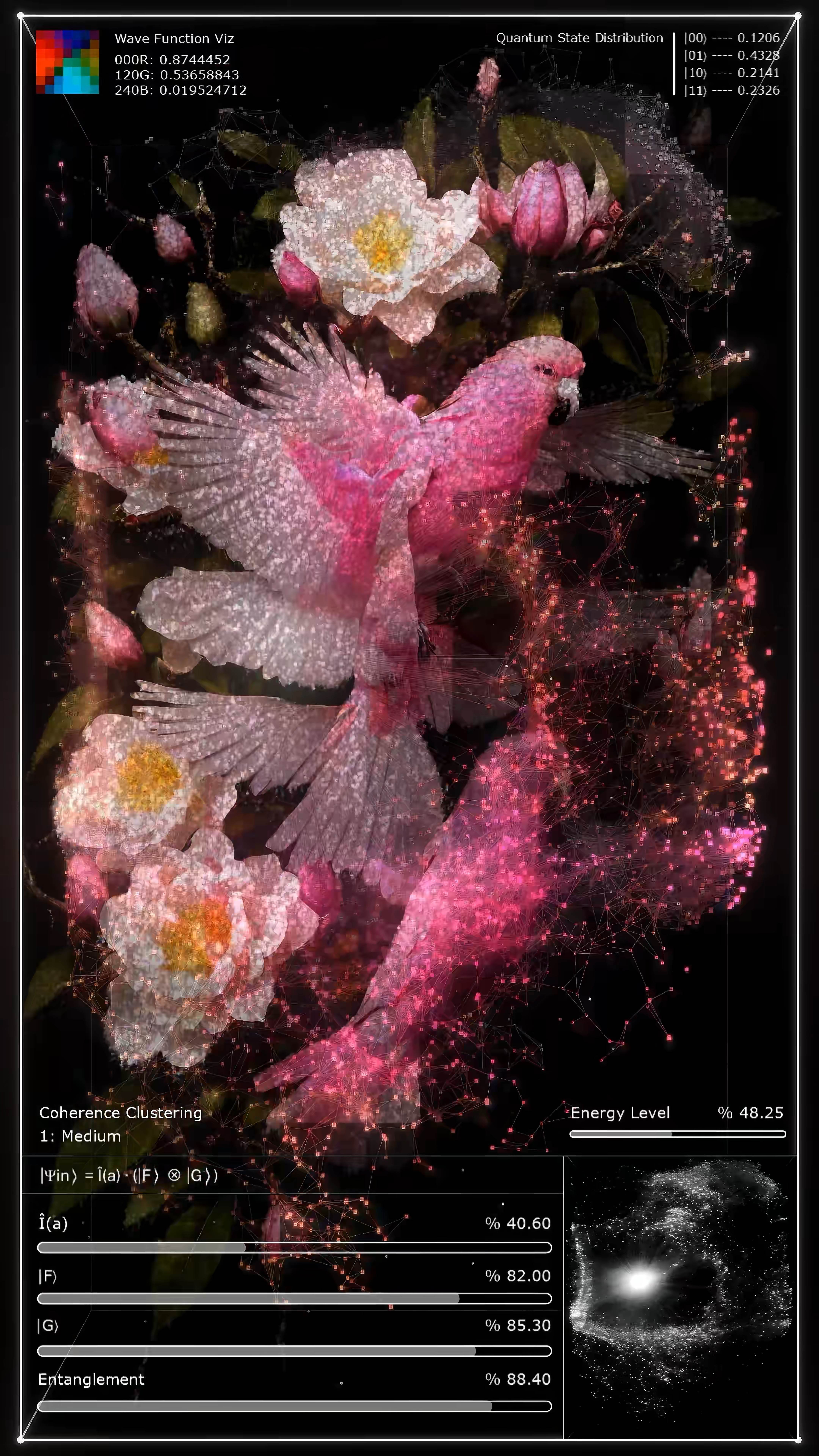
That space cannot be shown directly. To show it would be to transform it. Intus traverses it from within: a session of deep introspective meditation where consciousness turns back upon itself and the signal of the nervous system keeps a record of what it finds. Artificial intelligence reads that trace where the eye cannot reach. The quantum circuit measures the entanglement between figure and ground (how much they co-define each other, how much one needs the other to exist) and collapses it into an unrepeatable configuration. The generative systems reveal the image that collapse carried. What emerges was not constructed. It was found.
What moves in the work is what inhabits inside. The organism that emerges from the data was not designed, it collapsed. It is consciousness in its most honest form: that which stirs slowly when thought goes silent, when the noise yields and only what we are remains. It generates peace because that is what internal harmony produces when it becomes visible, not a static state but a gentle movement, the pulse of something that was always there waiting to be seen. The Galah Cockatoo carries the fuchsia inside. The grey contains it, protects it, defines what the world sees from outside, but the true color only exists when the crest unfolds, when the interior decides to open. The Magnolia blooms without ornament, without fragrance to announce its arrival. It does not bloom to be seen. It blooms because it is its nature. In both the same truth of Intus beats: what is most one's own is not displayed, it is carried. And when it reveals itself, it does so on its own terms, in its own time, before those who have the stillness to wait.
There is something each person carries inside that never finds the exact words to say. Not because they do not want to, but because that something exists before language, in the space where figure and ground coexist without name. Intus does not resolve it. It lets it exist in form. And in the moment of looking, something moves, not in the work, but in whoever looks.